


A Friendly Airflow DAG Build Tool for Data Engineer with YAML file template.
Warning
This project will reference the DAG generate code from the Astronomer: DAG-Factory. But I replace some logic that fit with ETL propose for Data Engineer.
Note
Disclaimer: This project will override all necessary parameters that should pass to Airflow object with ETL context for Data Engineer use-case. So, if you want to use and enhance this project, you can fork this project anytime without notice me.
| Airflow Version | Supported | Noted |
|---|---|---|
>2.7.1,<3.0.0 |
✅ | Common version support for Airflow version 2.x.x |
>=3.x.x |
✅ | Common version support for Airflow version 3.x.x |
Note
I recommend to use Airflow2 until Airflow3 stable.
Feature Supported:
- ✅ JSON Schema Validation (Set IDE with
json-schema.json) - 💚 Allow Passing Variable to DAG Template before build
From my opinion, a data Engineer should focus on the user requirement instead of focusing on the Python code when it need creates a new DAG in our Airflow application.
So, this project focus for this plain to make sure that all DAG can readable and easy to maintain with the same standard when we want to scale up and out the Airflow application support 10 to 1000 DAGs.
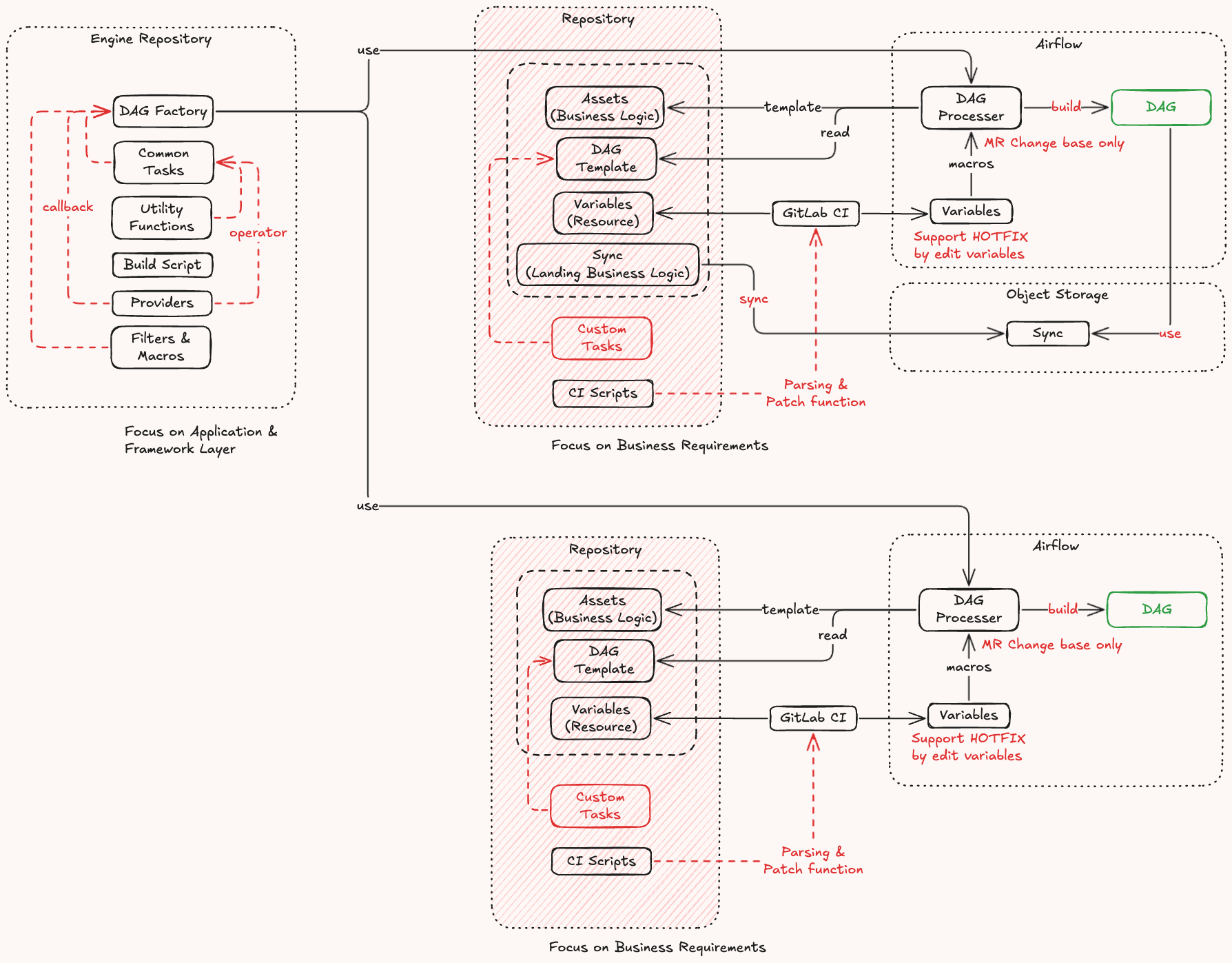
File Structure:
dags/
├── { domain }/
│     ├── { module-dags }/
│     │     ├── __init__.py
│     │     ├── dag.yml
│     │     ├── variables.yml
│     │     └── assets/
│     │         ├── dag-schema-mapping.json
│     │         └── dag-transform-query.sql
│     │
│     └── { module-dags }/
│           ├── __init__.py
Note
I think this project should support multiple DAGs structure like:
dags/
├── { domain }/
│     ├── { module-dags }/
│     │     ├── __init__.py
│     │     ├── dag-{ name-1 }.yml
│     │     ├── dag-{ name-2 }.yml
│     │     ├── variables.yml
│     │     └── assets/
│     │         ├── dag-case-1-schema-mapping.json
│     │         ├── dag-case-1-transform-query.sql
│     │         ├── dag-case-2-schema-mapping.json
│     │         └── dag-case-2-transform-query.sql
│     │
│     └── { module-dags }/
│           ├── __init__.py
uv pip install -U commonThis DAG generator engine need you define the dag.yml file and set engine
object to get the current path on __init__.py file.
Note
If you want to dynamic environment config on the dag.yaml file, you can use a
variable.yaml file for dynamic value that marking on config template via macro
function, {{ vars('keystore-on-dag-name') }}.
On the dag-transaction.yml file:
name: transaction
schedule: "@daily"
owner: "de-oncall@email.com,de@email.com"
start_date: "{{ vars('start_date') }}"
catchup: "{{ vars('catchup') }}"
tags:
  - "domain:sales"
  - "tier:1"
  - "schedule:daily"
tasks:
  - task: start
    op: empty

  - group: etl_master
    upstream: start
    tasks:
      - type: extract
        op: python
        caller: get_api_data
        params:
          path: gcs://{{ vars("project_id") }}/sales/master/date/{{ exec_date | fmt('%y') }}

      - task: transform
        upstream: extract
        op: operator
        operator_name: gcs_transform_data
        params:
          path: gcs://{{ vars("project_id") }}/landing/master/date/{{ exec_date | fmt('%y') }}

      - task: sink
        upstream: transform
        op: common
        uses: write_iceberg
        params:
          path: gcs://{{ vars("project_id") }}

  - task: end
    upstream: etl_master
    op: empty
On the __inti__.py file:
"""# SALES DAG

This DAG will extract data from Google Cloud Storage to Google BigQuery LakeHouse
via DuckDB engine.

> This DAG is the temp DAG for ingest data to GCP.
"""
from dagtool import Factory, ToolModel, BuildContext

from airflow.models import DAG
from airflow.utils.dates import days_ago
from airflow.utils.task_group import TaskGroup
from airflow.operators.empty import EmptyOperator

# NOTE: Some external provider operator object.
from airflow.providers.google.cloud.operators import MockGCSTransformData
from pydantic import Field

# NOTE: Some function that want to use with PythonOperator
def get_api_data(path: str) -> dict[str, list[str]]:
    return {"data": [f"src://{path}/table/1", f"src://{path}/table/2"]}

# NOTE: Some common task that create any Airflow Task instance object.
class WriteIcebergTool(ToolModel):
    """Custom Task for user defined inside of template path."""

    path: str = Field(description="An Iceberg path.")

    def build(
        self,
        dag: DAG,
        task_group: TaskGroup | None = None,
        build_context: BuildContext | None = None,
    ) -> TaskGroup:
        with TaskGroup(
            group_id="write_iceberg",
            parent_group=task_group,
            dag=dag,
        ) as tg:
            t1 = EmptyOperator(task_id="prepare", dag=dag)
            t2 = EmptyOperator(task_id="write", dag=dag)
            t2.set_upstream(t1)
        return tg


factory = Factory(
    name="sales",
    path=__file__,
    docs=__doc__,
    operators={"gcs_transform_data": MockGCSTransformData},
    python_callers={"get_api_data": get_api_data},
    tools={"write_iceberg": WriteIcebergTool},
)
factory.build_airflow_dags_to_globals(
    gb=globals(),
    default_args={"start_date": days_ago(2)},
)Output:
The DAG that was built from this package will have the name is, sales_transaction.
Note
On the variables.yml file that will set different stage area variables:
type: variable
variables:
  # NOTE: The key name that will get from the Airflow Variable or the local
  #   variable file.
  - key: transaction
    stages:
      dev:
        start_date: "2025-01-01"
        catchup: false
        project_id: "sales_project_dev"
      prod:
        start_date: "2025-01-31"
        catchup: true
project_id: "sales_project"- Support Airflow Parameter
- Support Airflow Asset
- Support Backfill for Hotfix
- Support Declarative template
I do not think this project will go around the world because it has specific propose, and you can create by your coding without this project dependency for long term solution. So, on this time, you can open the GitHub issue on this project 🙌 for fix bug or request new feature if you want it.