This project is a public, simplified demonstration of a custom bootloader framework I originally developed for enterprise embedded systems.
The production system was deployed in security-critical environments (finance, automotive, industrial control) with features such as:
- TPM-based secure boot and attestation
- Encrypted signature verification and hardware-backed chain of trust
- Deterministic real-time scheduling with sub-millisecond interrupt handling
- Regulatory compliance and hardened fault-tolerance mechanisms
This demo version keeps the architectural spirit and technical patterns, while simplifying security and runtime features for educational and portfolio purposes.
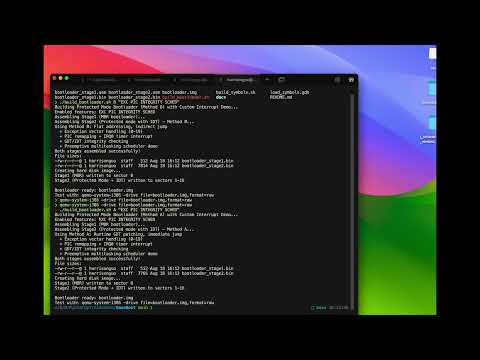
This 40-second video highlights:
- Real → Protected Mode transition
- GDT / IDT initialization
- Exception vector handling (0–19)
- PIC remapping + IRQ0 timer interrupt
- Preemptive round-robin scheduler (tasks A/B/Idle)
📺 Watch on YouTube — No audio
- Showcase system programming expertise on x86 boot and kernel primitives
- Provide an architecture-level view of real production bootloaders
- Share educational code with the community (low-level OS concepts)
- Document the translation of enterprise requirements into technical design
- Two-stage boot sequence: Stage1 MBR (512B) → Stage2 protected mode framework
- Protected mode setup: GDT/IDT initialization, interrupt remapping, exception handlers
- Feature-toggled build system: Selective compilation of subsystems (
EXC,PIC,INTEGRITY,SCHED) - Preemptive multitasking demo: Hardware timer (IRQ0) driving a round-robin scheduler
| Feature | Production (Enterprise) | Demo (Open Source) |
|---|---|---|
| Secure Boot | TPM attestation, encrypted signatures, trust chain | Checksum validation (SGDT/SIDT) |
| Interrupts | Priority-based routing, deterministic latency | PIC remap + timer IRQ, basic ISR |
| Scheduling | Priority, RT guarantees, IPC | Round-robin, 3 tasks (A/B/Idle) |
| Exception Handling | Fault isolation, encrypted crash reports | Simple vector table + hex dump |
| Portability | Multi-platform x86 embedded | Flat model / runtime-patched GDT |
├── bootloader_stage1.asm   # Stage1: MBR (16-bit real mode)
├── bootloader_stage2.asm   # Stage2: Protected mode + features
├── build_bootloader.sh     # Build script with feature flags
├── build_symbols.sh        # Debug symbol generation
├── load_symbols.gdb        # GDB loader for QEMU debugging
└── README.md               # This document
# Method A: Runtime GDT patch (legacy platforms)
./build_bootloader.sh A

# Method B: Flat addressing (modern platforms)
./build_bootloader.sh B

# With features
./build_bootloader.sh A "EXC PIC INTEGRITY SCHED"
Run in QEMU:
qemu-system-i386 -drive file=bootloader.img,format=raw- Base: "METHOD A/B + IDT" → "IDT SETUP" → "INT 0x30 TRIGGERED"
- PIC enabled:
TICKS:XXincrements in real-time - Integrity check: Displays GDT/IDT checksums
- Scheduler enabled: Task indicators cycle (
A → B → I) with counters updating
- Real → Protected mode transition
- GDT/IDT setup and exception handling
- PIC reprogramming and hardware interrupt handling
- Preemptive scheduling via context switching
- Boot-time integrity validation mechanisms
- System programming (x86 assembly): low-level bootloader + kernel mechanisms
- Interrupt and scheduling design: hardware timer-driven context switching
- Security mindset: integrity checking, trust chain concepts
- Production experience: Translating enterprise security & real-time requirements into implementable architectures
This repository demonstrates how production-grade embedded bootloader concepts can be distilled into an open-source educational framework, while still highlighting:
- Engineering depth (secure boot, interrupts, scheduling)
- Architecture clarity (modular feature toggles, dual addressing models)
- Practical coding ability (working bootloader in <5KB)
It bridges the gap between commercial system design and teaching-oriented open source, showcasing both engineering rigor and technical communication.
💡 When to choose bare-metal vs RTOS?
It depends on requirements — not hype.
This repository contains no proprietary or confidential code.
It is a clean-room educational implementation, inspired by architectural
patterns originally designed for production environments.