Arduino Nano sketch for for Si5351 VFO and Bob Fontana AK3Y's Tuna Tin S QRPp CW Transmitter
This Arduino Nano Si5351 VFO code designed for the Tuna Tin S, a low power amateur radio radiotelegraphy (CW) transmitter designed by Bob Fontana, AK3Y, can also be used for a general purpose variable frequency oscillator. The full circuit description and construction details are published in December 2020 QST Journal with an update in the September 2022 issue https://www.arrl.org/qst .
The Tuna Tin S transmitter is comprised of two circuits: See Hardware Diagrams
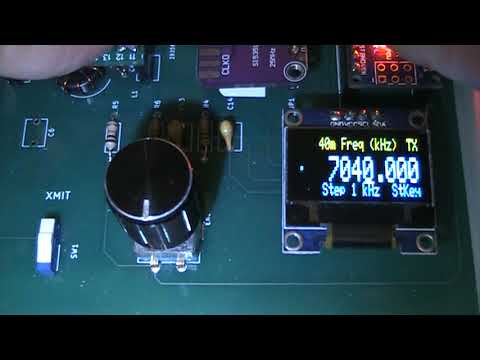
- an Arduino Nano microcontroller, an EC11 (KY-040) rotary encoder with push-button, an Si5351 frequency synthesizer module, a 128x64 pixel OLED digital frequency readout; and,
- an IRF510 MOSFET RF power amplifier with a 7 MHz Class E output filter network. The typical power output is 0.5 watts. A distinct output filter is required for operation on each frequency band. The NMØS Class E filter design tool is available at Class E Design Spreadsheet or this spreadsheet.
The original Arduino sketch code set up the Si5351 module for operation within one frequency band. An encoder switch allowed selection of frequency and tuning steps within that one band. The author's original Arduino sketch codes are accessible to ARRL members in the https://www.arrl.org/qst-in-depth archive for December 2020. This updated Arduino sketch is based on Fontana's original code with the enhancements enumerated below.
The original sketch required installation of the Adafruit SSD1306 (Adafruit_SSD1306.h) and the Adafruit Si5351 (Adafruit_SI5351.h) Libraries into the Arduino IDE for compilation.
Use the Arduino IDE Library Manager to install the Adafruit SSD_1306 library and NT7S's Etherkit Si5351 library before compiling this sketch. The Upload Procedure for the libraries and sketch is posted in the Wiki
TunaTinS v2.3.1 is a significantly innovative update for Arduino Nano VFO sketches.
Variations in the Si5351's quartz crystal tolerance can typically cause an output frequency error of up to 1 or 2 kHz at HF frequencies. Other published Arduino VFO sketches describe a frequency calibration procedure that requires measuring the difference of the Si5351 quartz crystal or output frequency and its programmed frequency and manually calculating the correction factor;
Correction Factor (PPB) = (Measured Frequency - Programmed Frequency)/Programmed Frequency x 1,000,000,000
or uploading a separate Si5351 calibration sketch that determines the correction factor using keyboard input to tune the Si5351 until its output matches a reference frequency. In either case, the procedure usually requires the inconvenience of loading another sketch into the Arduino IDE, manually editing the correction factor, recompiling, and uploading the VFO code into the Arduino, all of which can introduce errors.
The better practice described here eliminates those extra tasks and increases user convenience by incorporating the frequency calibration calculations and storage into the main VFO sketch with the addition of: a few variables; several lines of code; and storing the ppb correction factor in non-volatile EEPROM memory. The user can now calibrate the Si5351 frequency to 0.1 ppm using the rotary encoder and a receiver tuned to WWV or other accurate 10 MHz frequency standard or a frequency counter and save it to non-volatile memory with a button push. This code update is deeply optimized for memory size and execution speed and is significantly improved.
After calibration, your Si5351 VFO frequency will be accurate to within 0.1 ppm, e.g., within 1 Hz at 10 MHz, and can also serve as a secondary frequency standard over its entire 4 kHz to 255 MHz range. Variations in ambient temperature can also cause a frequency drift of about 1-2 Hz at HF frequencies.
The Tuna Tin S v2.3.1 is a compact, Arduino-based QRP telegraphy transmitter with:
- Si5351 frequency synthesizer
- OLED display (128×64, SSD1306)
- EC11 (KY-040) rotary encoder with push-button
- TR switch input for transmit mode
- Straight key or iambic keyer adjustable from 8 wpm to 40 wpm.
- In addition to controlling the Tuna Tin S transmitter frequencies, the software allows the Si5351 to serve as a low-level signal source (VFO) continuously variable from 4 kHz through 225 MHz.
- The software incorporates a frequency calibration mode that can achieve 0.1 ppm accuracy over that frequency range. The calibration factor is stored in non-volatile EEPROM memory.
- Starting with version 2.3.1 the 60 meter band can be accessed as either discrete channels or the WRC-15 5351.5 - 5366.5 kHz band.
- Each of the 15 amateur radio frequency bands defaults to its QRP CW calling frequency upon power up.
- Each frequency band retains its last used frequency in memory while powered up.
- The user may define and store a default startup frequency in non-volatile memory.
- The frequency calibration factor (ppb) and the user-defined default startup frequency are stored in EEPROM memory that retains the data even when the power is off.
- NT7S’s Etherkit Si5351 library replaces the Adafruit Si5351 library in the original sketch. This Etherkit Si5351 library automates the PLL setup and offers continuous RF spectrum coverage from 4 kHz through 225 MHz.
- The Si5351 synthesizer covers all 15 amateur radio frequency bands with presets for QRP calling frequencies from 137 kHz (2200m) through 222 MHz (1.25m).
- The encoder serves multiple functions: Rotation adjusts a frequency digit or step size. A quick tap (<0.5s) alternates the encoder between digit select and digit adjust modes. A medium press (0.5-2s) toggles between normal operating mode and calibration mode. A long press (>2s) saves the displayed frequency as a user-defined startup frequency (in normal mode) or saves the displayed ppb crystal correction factor (in calibration node) into non-volatile EEPROM.
- The tuning steps are now: Band change, 1 MHz, 100 kHz, 10 kHz, 1 kHz, 100 Hz, 10 Hz and 1 Hz, in either direction. The 60m band tuning steps through the USA's five discrete 5 MHz channels.
- The integrated frequency calibration function permits setting the crystal correction factor to 0.1 ppm and saves it into non-volatile EEPROM.




Please contact our team via https://groups.io/g/DIYRadio or mailto://contact@n6na.org if you wish to:
- Report a bug
- Discuss the current state of the code
- Submit a fix
- Propose new features
Thank you!